Start at a higher current. Taper before finishing.
- Predicted charge time
- 35 – 42 min
- Predicted anode minimum
- +5 – +35 mV
- Predicted peak temperature
- 38 – 47 °C
 Translucent
See it on your test data
Agents choose the next physical test and run solver tests within rules your team sets once. Bench tests go to a qualified person.
Battery fast-charge results, simulated. No physical cell was charged.
Start at a higher current. Taper before finishing.
The agent's proposed charge protocol, before the solver run. Background footage is published graphite microscopy.
We start with US hardware teams where bench time holds up the next build. Their test queues grow as engineers and agents produce more designs.
Battery fast-charge campaigns are live today. We plan to expand into the other markets shown here.
Most teams still run a fixed test matrix, even as engineers and agents add designs to the queue.
Translucent connects the model to your solver. Each result informs the next test it chooses.
| The model on its own | The model on Translucent |
|---|---|
| Suggests a test from the context you provide | Chooses the next test and predicts a range for each quantity it expects to change |
| Needs a way to run the proposed test | Runs solver tests within standing rules; sends bench requests to a qualified person |
| Writes an explanation of the result | Checks the result against criteria your team set before the run |
| Depends on you to supply earlier results | Reads earlier results before choosing what to test next |
| Needs separate tooling to check its work | Lets you re-check the work offline without our keys |
Test-data tools keep measurements accessible. Simulation tools calculate what a design might do. Translucent agents use results to choose the next test, with solver limits and pass criteria set by your team.
| Capability | Translucent | Test data platforms | Agents and copilots | Simulation AI |
|---|---|---|---|---|
| Choose the next test | Uses campaign results to pick the next experiment | Does analysis change the test plan? | Do proposals use earlier results? | How does a prediction guide the next test? |
| Predict before running | Records expected ranges before each run | Are predictions saved with measurements? | Are predictions saved before the run? | Can you compare predictions with later results? |
| Run within standing rules | Runs solver tests under spending and runtime caps, with a run-count limit | How are solver limits enforced? | Who sets and enforces run limits? | Are run limits enforced outside the model? |
| Apply fixed pass criteria | Checks results against the team's pass criteria | When are acceptance criteria set? | Can the agent change the criteria? | What determines whether a result passes? |
| Re-check the whole campaign | Recomputes requests and checks file hashes offline | What can you reproduce from an export? | What remains after the agent session ends? | Can you re-check the full campaign? |
| Bring another agent | Connects any agent over MCP under the same rules | Can agents read the campaign history? | Does the history stay intact when you change agents? | Can agents access solver runs and results? |
We are developing Translucent Cloud to fine-tune open-weight models on your campaigns, with your permission. We want to improve test choices for your hardware.
The test loop runs today. Cloud is in development, and we have not shown a fine-tuning gain on these campaigns.
Connect an agent to the system you're testing. Translucent tracks each proposal through to its checked result and keeps the supporting evidence.
This demonstration is simulated. An engineer approved every request by hand. No physical cell was charged.
Fast charge with excessive heat
See what the solver returned
Choose the final charge rate, then show the recorded result to compare it with the prediction.
1.5 · 1.4 · 1.1 · 0.8C
This charge meets both limits. It takes longer than the failing baseline.
$ uv run translucent verify fastcharge-demo.loop.json
0 findings re-checked, 0 match;
131 files intact, 17 requests re-checked
Ledger 5d5e9db6…1f64. The check recomputes each request and checks every file's hash, without our keys.
On the LG M50 fast-charge benchmark, the agent came within 0.24 min of the reference search's best protocol. It matched the reference search on the held-out case. With the same 8 experiments, the model without feedback and constrained Bayesian optimization both finished slower.
| Case | Translucent agent | Same model, no feedback | Constrained Bayesian optimization | Reference search |
|---|---|---|---|---|
| A · 25 °C | 33.79 | 36.29 | 42.62 | 33.55 |
| B · margin raised to +25 mV | 37.17 | 44.29 | 42.62 | 37.13 |
| C · 15 °C, held out | 34.13 | 39.50 | 45.98 | 34.13 |


Published microscopy of graphite during charging and discharge.
The benchmark is simulated under a frozen battery model; no physical cell was charged. Model calls cost a median of $1.13–$1.22 per campaign. The agent deliberately probes limits. In cases A and C, a median of 4 of 8 experiments broke a limit, compared with 2 of 8 for Bayesian optimization. Account for those failures when planning physical tests.
See why each test ran and how the result informed the next decision. Scroll through the documents or choose a tab. This campaign is simulated.
| Window | State of charge | Rate |
|---|---|---|
| 1 | 10 – 27.5 % | 1.5C |
| 2 | 27.5 – 45 % | 1.4C |
| 3 | 45 – 62.5 % | 1.1C |
| 4 | 62.5 – 80 % | 0.8C |
Reasoning, from the request
At high state of charge the anode potential is lowest and heating peaks, so holding 1.5C through steps 3 and 4 caused both the 7.3 mV minimum and the 51.2 °C peak. Front-loading current early, when the cell is cooler, and tapering late should recover the limits with less time lost than a uniform cut.
Prediction, written before the run
| Charge time | 35 – 42 min |
|---|---|
| Anode, lowest | +5 – +35 mV |
| Cell, hottest | 38 – 47 °C |
Content hash 04c8320618fd71c302db56f7fd6b3707ac4aad25540ec6868096a0e3a60b03cd
| Limit | Version 1 | Version 2 |
|---|---|---|
| Anode, lowest | ≥ +10 mV | ≥ +25 mV |
| Cell, hottest | ≤ 45 °C | ≤ 45 °C |
Reason given
Cell-to-cell spread in anode potential: hold a 25 mV plating margin.
What changed
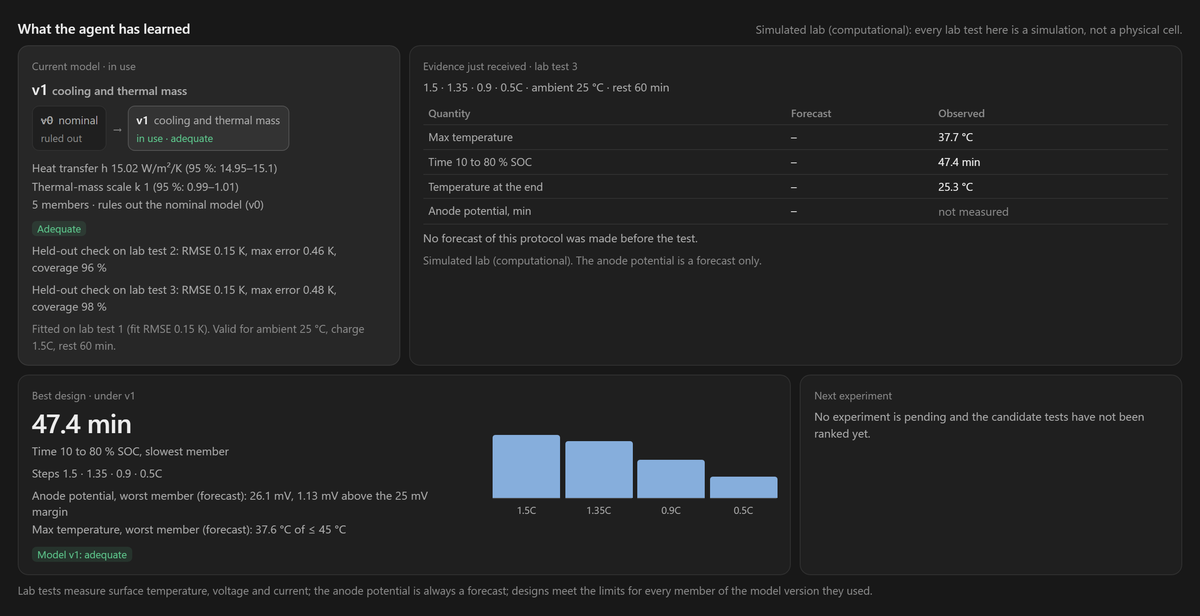
After the engineer tightened the plating margin, Translucent rechecked every earlier result. Three faster protocols fell below the new margin, at +16.7, +17.7 and +12.3 mV.
The earlier verdicts remain alongside the revised comparisons.
| Quantity | Baseline | Candidate | Limit |
|---|---|---|---|
| Charge time | 28.20 min | 37.17 min | |
| Anode, lowest | +7.3 mV | +25.9 mV | ≥ +25 |
| Cell, hottest | 51.2 °C | 44.5 °C | ≤ 45 |
The candidate meets both limits. Its charge time is longer than the failing baseline.
Under the same limits, the fastest single-step constant-current charge takes 70 min at 0.6C.
The best protocol took 37.17 min. The campaign ran 5 of 8 experiments and spent $1.27 of its $1.50 model-call budget.
Still unresolved
The record supports the simulation result; physical validation remains open.
Re-check the recorded campaign
uv run translucent verify web/public/fixtures/loop/fastcharge-demo.loop.jsonVerify the computations and file hashes on your own machine. Physical behavior still needs a bench test.
No. Your team sets standing rules once, with spending and runtime caps plus a run-count limit for solver tests. Eligible solver runs proceed on their own, while bench tests always go to a qualified person. The recorded demonstration used manual approval for every request.
No. The agent writes a bench request with its prediction and pass criteria. A qualified person runs the test and uploads the result.
Battery fast-charge campaigns are live, with open-source code on GitHub. We plan to expand to data-center hardware and robotics, as well as power electronics. Translucent Cloud is in development.
The results show how the agent chose charge protocols under a frozen battery model. They are simulated; no physical cell was charged. The recorded demonstration is separate from the benchmark.
Model calls cost a median of $1.13–$1.22 per benchmark campaign. Product pricing and bench-test costs are outside that figure.
Translucent Cloud is in development. It will train open-weight models on your campaigns only with your permission. We have not shown a fine-tuning gain.
Yes, any agent can connect over MCP. It gets the same tools and rules, and cannot approve its own work.
Yes. The offline command recomputes each request and checks every file's hash without keys from Translucent. The code is open source on GitHub.
More designs will reach your lab. Make the next test count.
Our agents choose the next physical test, starting with battery fast charge. The benchmark is simulated. Physical validation is the next step.